Model
Chassis No.
Engine No.
Year
Registration No.
Coach Builder
Body Name
Main Colour
Body Colour
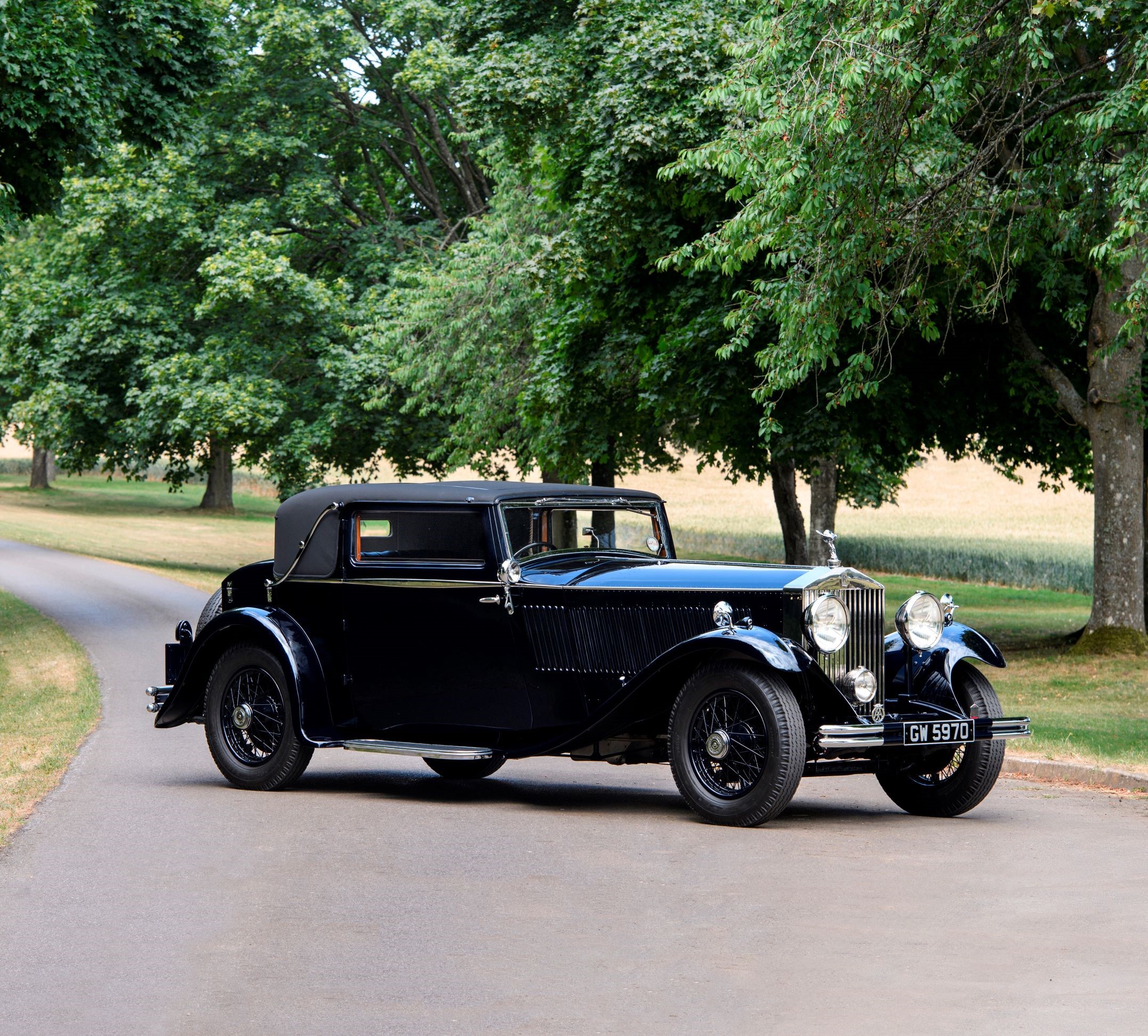
1932 Phantom II Continental (72JS) Thrupp & Maberly Fixed Head Coupe
owned by The Hon Sir Michael Kadoorie
Model Phantom II Continental
Year of Manufacture 1932
Engine No EG55
Coachbuilder Thrupp & Maberly
Registration No GW-5970
Chassis No 72JS
Body name/type Fixed Head Coupe
Body colours Blue
Main colour Blue
72JS was ‘On Test’ on 9th March 1932 and ‘Off Test’ on 15th March 1932. With a short continental wheelbase and low ‘F’ rake steering suitable for an owner driver, 72JS was delivered to Thrupp & Maberly on 15th March 1932 for the construction of a Fixed Head Coupé body (body number 5427). The completed car was inspected at Thrupp’s on 21st April by Rolls-Royce Ltd who issued the guarantee (number 8091, later amended to 8292) on 23rd April 1932.
72JS was sold to the 20-year-old HH Prince Aly Khan, of 4a Halford Street, by J Smith & Company (Motor Agents) of 28 Albemarle Street, London W1, better-known as sole concessionaires for Delage cars, although the chassis card was made out in the name of Rootes Ltd of Devonshire House, Piccadilly. The reason for this is probably that the coachbuilder of Aly Khan’s car, the old-established firm of Thrupp & Maberly, a company that dated back to 1760, had been part of the burgeoning Rootes organisation since 1925. Smith may have made the sale, but the chassis and body had been supplied by Rootes. His Highness is recorded as the owner by Rolls-Royce Ltd on 18th May 1932.
The Phantom II was a coming-of-age present for Prince Aly Khan from his father the Aga Khan, the 48th hereditary Imam of the Ismaili Muslims, the second-largest branch of Shia Islam. Aly Khan had been born on 13th June 1911 in Turin, to the Aga Khan’s second wife, Cleope Teresa (Ginetta) Magliano, an Italian-born former dancer with the Ballet Opera of Monte Carlo. The Aga Khan, incidentally, was in London for the coronation of King George V at the time.
Aly Khan had been given a ‘thoroughly Western’ education. Nevertheless, after a period in London during 1929 whilst studying law, he paid a visit to Syria in August 1930 in which, as the heir apparent to the Aga Khan, he was accorded a darbar (royal pageant) and appeared in Arab costume riding a white horse, in accordance with Ismaili tradition. However, it was said that the young prince was more interested in racing cars, breeding racehorses and making love than performing his official duties. It has to be said that in later years he took his role as the heir apparent of the Ismaili faith more seriously, travelling for three months of the year to visit Ismaili communities in Asia, Africa and South America, using his twin-engined De Havilland Dove to make an otherwise impossible schedule feasible. But bon vivant at heart he remained; although at the time that he acquired the Phantom II Continental, he had not achieved the notoriety that would make his many affairs headline news.
His birthday Continental, a masterly design by Thrupp & Maberly, in which a bonnet nine inches longer than normal and louvres running through into the scuttle made the car seem long and sporty, giving the illusion that the engine compartment occupied almost half the car’s considerable length. This feature obviously pleased Aly Khan so much that it was repeated on his next Rolls-Royce, a Gurney Nutting-bodied 20/25 (GEX25) delivered in 1933.
The brightwork of the Continental was in stainless steel and the fixed head was covered in alpaca twill with dummy hood irons. There was, apparently, one feature that displeased the young prince: as built, the wings had prominent skirts, which he ordered eliminated to create the flowing wing lines apparent today. Short running boards filled the gap between front and rear wings.
Aly Khan, however, did not keep his cars long, but had covered some 30,000 miles in 72JS by the time he sold the car in January 1933. Soon after he acquired a second Continental (41MW), this time a Park Ward touring saloon, in addition to a standard Phantom II Park Ward Saloon (116MY) and the long-bonneted 20/25. That frequent procession of bespoke motor cars would continue throughout his life until, unexpectedly bypassed in the succession in favour of his son, Prince Karim, he was killed in May 1960 at the wheel of his Lancia Flaminia on his way to a dinner party in Paris with his current mistress, colliding head-on with another car that had strayed on to the wrong side of the road.
After Aly Khan’s all-too-short ownership, 72JS was acquired on 19th January 1933 by EW Bailey of Hollington, Ross, Hereford and, later in 1934, Glewstone Court, Glewstone, Hereford. His family business, Westons Cider, was based in the Herefordshire village of Much Marcle and had a history of premium cider-making going back to 1880. He was to keep the car until 1949.
In 1951, Richard Lowe, an engineer working on the extraction of oil from Shell’s Lake Maracaibo field in Venezuela, was at Tadworth in England on leave. He was looking for a car to replace the Riley Nine Monaco saloon that had been his everyday transport for three years, during which it had successfully been coaxed to the summit of the 14,000ft Pico El Águila pass from Colombia to Lake Maracaibo. Rolls-Royce Ltd recorded Richard Lowe as the owner on 12th February 1951, living at The Grey House, Colwell, Malvern, Worcestershire, and later in November 1962 at Blue Haze, Eyhurst Close, Tadworth, Surrey. Writing in 1969, he recalled: ‘As a more powerful car was required to compete with the latest Detroit products favoured by friends, a Phantom II appeared to have all the right characteristics, and this was confirmed after trying out a number of them in Yorkshire, where even carrying a three-ton load they sailed up the hills with complete nonchalance.’ He had almost given up hope of acquiring a Phantom II when he spotted an advertisement offering 72JS for sale. By then, it had covered some 90,000 miles and was the property of a retired colonel in Cheltenham who had only owned the car for a few months; presumably, he was finding his army pension was not up to running a Rolls-Royce.
‘The sale was agreed the same day’, said a jubilant Richard Lowe. When he returned to Venezuela, the Continental travelled with him. Unfortunately, it shared the hold with a cargo of West Indian sugar, which spilt, and wherever a grain of sugar landed on the body of the Rolls-Royce, it dissolved the cellulose paintwork, creating ‘an interesting patina’. The car also suffered some mechanical damage on the voyage. Nevertheless, recalled Richard Lowe, ‘This car created a sensation in Maracaibo, western Venezuela, as it was the only Rolls-Royce there and possibly the first one that the Venezuelans had ever seen. Wherever it stopped, a crowd would gather and subject it to a minute examination.’ Indeed, Rolls-Royces were so rare in Venezuela that even the enthusiastic Richard Lowe only saw one other during the years he spent there; it was a Phantom III that had previously belonged to a president of the republic. Running a Rolls-Royce in Venezuela was not prohibitively expensive, since petrol was only the equivalent of sixpence a gallon. ‘Therefore,’ happily recalled Richard Lowe, ‘the tank could be filled for ten shillings!’ As a precaution against dust, since there were many unsurfaced roads to contend with, an oil bath air filter was fitted: ‘Even in UK, this traps large quantities of dirt,’ Mr Lowe commented. Another hazard was the tropical weather. ‘The sliding roof drainage system, which comprised lead pipework, did give trouble as it was quite incapable of coping with the rate of rainfall experienced in the tropics. The roof therefore was covered in to stop the rain getting inside.’ When maintenance problems occurred, Rolls-Royce Motors proved extremely helpful in providing both technical advice and a supply of suitable spare parts. Work carried out included decarbonising the engine and the replacement of a cracked brake drum.
Having covered some 30,000 miles in Venezuela, the Phantom II was brought back to England in 1954. Subsequent work on the chassis included a complete overhaul and resetting of the front springs, relining the clutch and crankshaft damper, new big and little end bearings and new piston rings. Electrical work encompassed rewinding the magneto and an overhaul of the dynamo. In May 1964, Richard Lowe and the Phantom took part in the Rolls-Royce 60th Anniversary Rally at Goodwood, attended by some 1,100 Rolls-Royce and Bentley motor cars and described by Bill Boddy of Motor Sport as ‘the biggest one- (or two-) make assembly of all time, and completely overwhelming. This mammoth assembly sparked Richard Lowe’s interest in the Rolls-Royce Enthusiasts’ Club, which he joined, attending many of the club’s rallies. In 1969, he noted wryly, ‘The highlight of these was achieved at Stowe School on 7th September of this year, where the car received first prize under Class 11 (car considered most ripe for restoration).’ Spurred on by this somewhat negative award, Richard Lowe put remedial work in hand, ‘with the ultimate objective of obtaining first prize under Class 6 (best paintwork).’
Richard Lowe kept the car for many years, and it had long been admired by Sir Michael Kadoorie. Eventually, accompanied by Keith Bowley, he visited Richard Lowe and — presenting him with a copy of Raymond Gentile’s book on the Phantom II Continentals — said, ‘If you ever think of parting with this car, I’d love to have it.’
In the meantime, after looking at fourteen Rolls-Royce Phantom IIs, in 1992 Sir Michael had acquired the 1934 Continental chassis number 60SK with Gurney Nutting Owen Sedanca coachwork. It won Best of Show at the Rolls-Royce Enthusiasts’ Club Concours d’Elegance in 1995.
A photograph of the winning car duly made the front cover of the RREC Bulletin; Richard Lowe, having struggled to change a punctured wheel, realised that his Continental was getting too heavy for him, saw the picture and contacted Keith Bowley, saying, ‘I see Sir Michael has a Continental; I don’t expect he would want another’.
‘Oh yes, I would’, said Sir Michael when Keith told him of Lowe’s call. But whilst Richard Lowe was willing to sell his Rolls-Royce to Sir Michael Kadoorie, it transpired that his wife was as much in love with the lovely Continental as her husband had been and refused to let him sell it. It took a further two years before she relented and agreed to the sale, and Richard Lowe finally parted with the Continental in 1998. Its replacement? A Derby Bentley…
After the transaction was completed, 72JS was entrusted to Keith Bowley and a three-year ‘nut and bolt’ restoration to as-new condition ensued. The car won a second class award at the annual concours of the Rolls-Royce Enthusiasts Club in 2004, but this was eclipsed in 2015 when the Thrupp & Maberly Continental won the Cars of the Aga Khan class at the Arts & Elegance Richard Mille Concours d’Elegance at the Château de Chantilly.
In writing this description, Sir John Stuttard is grateful to have had access to Sir Michael Kadoorie’s biographical work Driven by Passion, The Motor Cars of the Hon Sir Michael Kadoorie, by David Burgess-Wise.
| First Name | Last Name | |
|---|---|---|
| Sir Michael | Kadoorie | [email protected] |